

TAVR in Bicuspid Aortic Valve: Challenges and Advances in Valve Sizing
Transcatheter Aortic Valve Replacement (TAVR) has transformed the treatment of severe aortic stenosis. Once indicated for patients at high surgical risk, it is now expanding to younger, lower-risk individuals. This expansion naturally includes more patients with bicuspid aortic valves (BAV),a common congenital condition that affects 1–2% of the population.
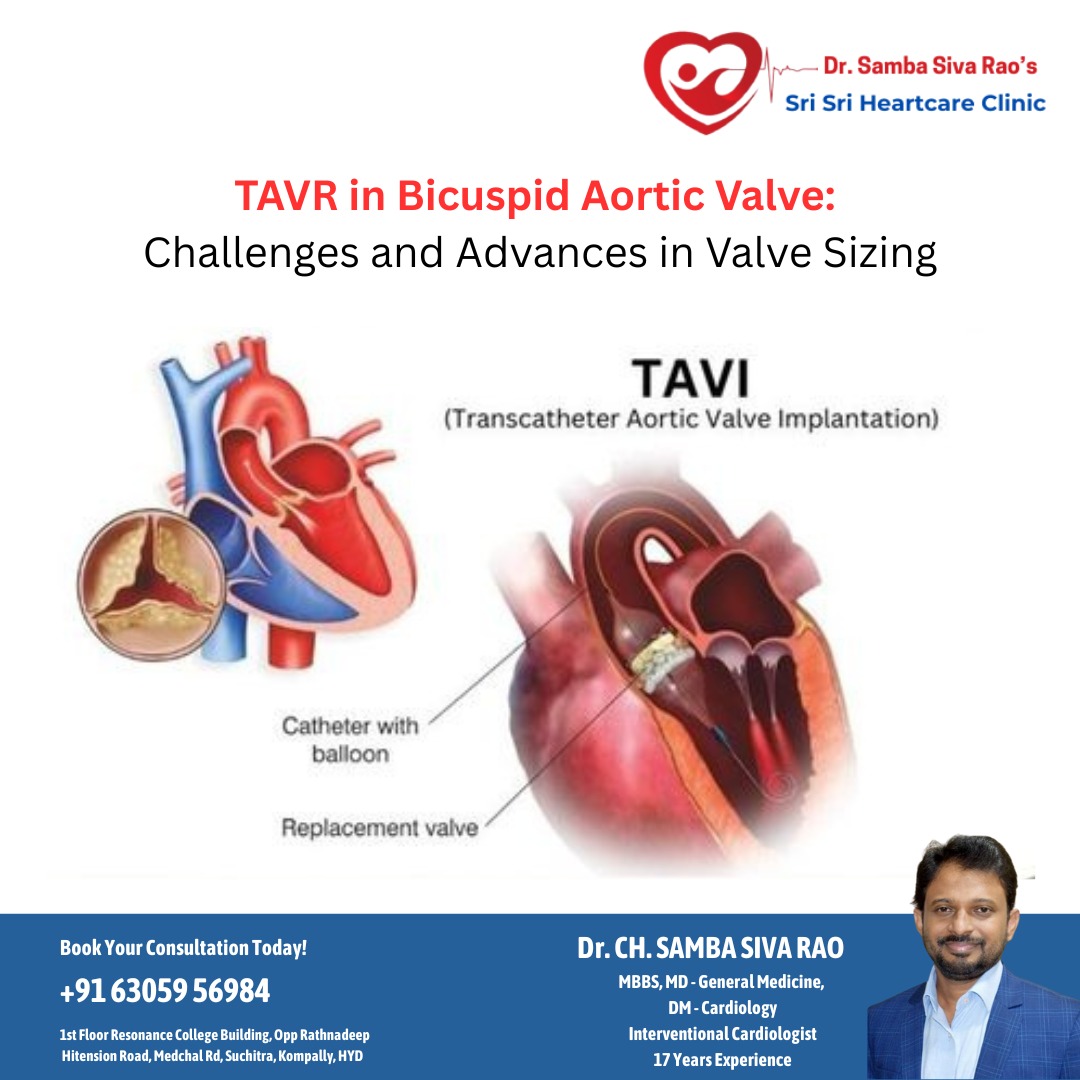
Why Bicuspid Aortic Valves Are Different
In a tricuspid aortic valve, three leaflets form a near-perfect circle. In BAV, there are only two leaflets, usually asymmetrical and with a ridge of fused tissue (raphe). BAV anatomy tends to be:
1) Elliptical opening rather than round2) Larger in dimension with varying shapes (tubular, tapered, or flared)
3) More heavily calcified, especially along the raphe
4) Sometimes associated with aortic root or ascending aorta dilation (aortopathy).
These differences challenges the TAVR in BAV, including risks of incomplete valve expansion, paravalvular leak, device malposition, or conduction issues requiring a pacemaker and aortic rupture.
The Importance of Valve Sizing
The success of TAVR depends on accurate valve sizing. Oversizing increases the risk of annular injury, while undersizing risks paravalvular leak or valve migration. BAV makes this trickier, as the landing zone ( valve gripping zone) is not always the annulus but may be supra-annular or influenced by calcified raphes.
Annular-Based Sizing
Annular-based sizing uses CT measurements at the annulus (valve ring). This is the most reproducible method and has been the gold standard. However, in BAV patients—especially with tapered anatomies—it may not reflect the narrowest functional diameter(landing zone), leading to valve underexpansion or distortion.
Supra-Annular Sizing and Root Configurations
Supra-annular sizing measures the intercommissural distance (ICD) about 4 mm above the annulus. The BAVARD registry first emphasized this approach, showing that BAV anatomy can be divided into three configurations:
1) Tubular – Annulus and ICD similar → annular sizing is reliable.
2) Flared – ICD larger than annulus → annular sizing prevents oversizing.
3) Tapered – ICD smaller than annulus → supra-annular sizing prevents choosing a valve too large for the functional landing zone.
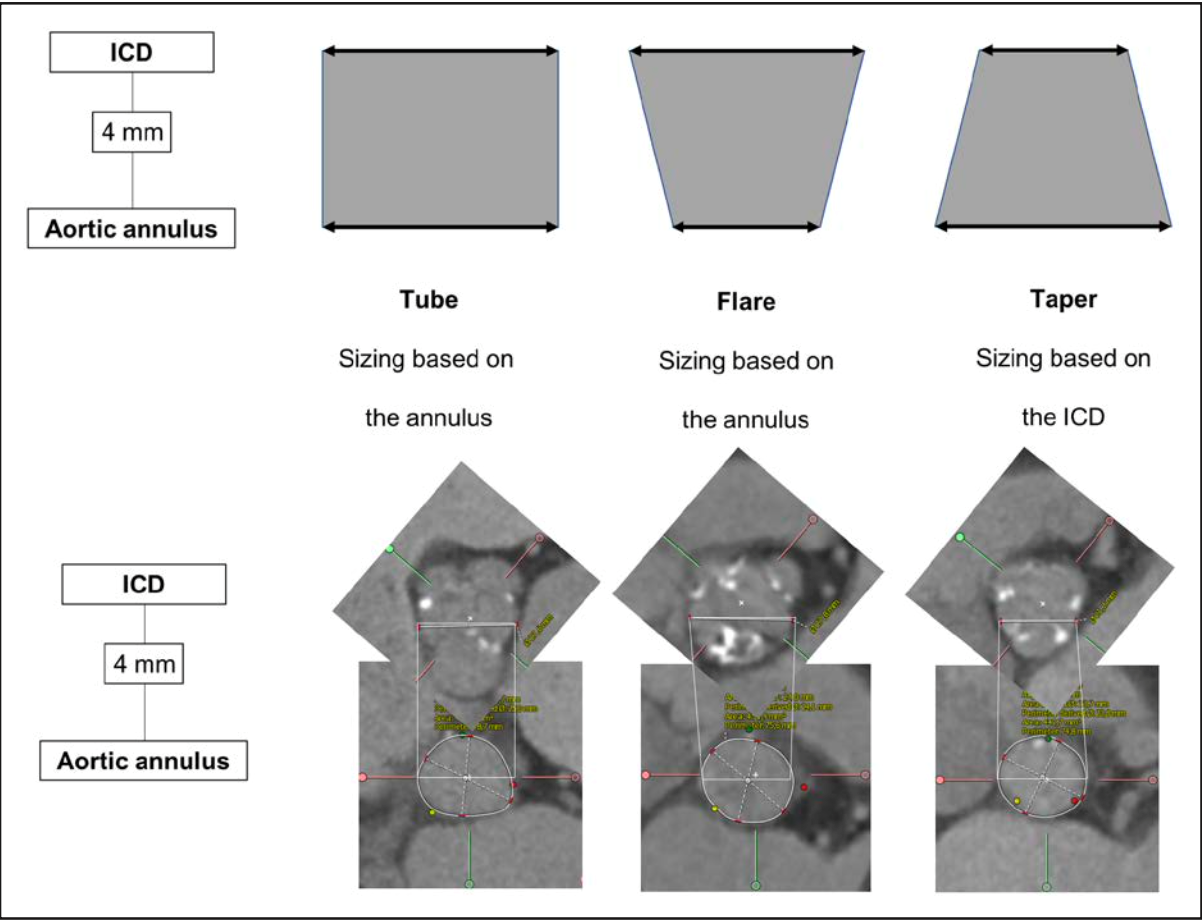
In the BAVARD registry, annular sizing was appropriate in 88% of patients, while 12%—mostly with tapered anatomy—benefited from supra-annular considerations.
Insights from the BIVOLUTX Registry
The BIVOLUTX registry (2023) studied 149 BAV patients undergoing TAVR with the self-expanding Evolut PRO and R valves across 14 countries. It specifically compared annular-only sizing vs combined annular + supra-annular sizing :
sizing strategies used : 52% annular-only, 48% combined with ICD.
Valve performance : 95% device success, with excellent hemodynamics (mean valve area 2.1 cm², mean gradient 7–8 mmHg).
Clinical outcomes: 30-day mortality was 2.6%, 1-year mortality 11%, with no significant difference between sizing strategies.
Valve durability: Function remained stable at 1 year, with minimal paravalvular leak and low severe patient-prosthesis mismatch rates.
Key takeaway: Both annular-only and combined supra-annular sizing performed equally well, reinforcing that annular sizing is safe for most cases, but supra-annular metrics add reassurance in anatomically borderline or tapered cases.
Raphe- and Calcium-Based Approaches
Raphe length and calcification (CASPER method: adjusts size selection based on calcification burden).
Neo-annulus definition at raphe level (LIRA method).
These are promising but still under evaluation in ongoing trials.
References
1) Tchetche D, et al. *Bicuspid Aortic Valve Anatomy and Relationship With Devices: The BAVARD Multicenter Registry.* Circ Cardiovasc Interv. 2019;12\:e007107.
2) Vincent F, et al. *CT-Based Aortic Annulus and Root Sizing for Transcatheter Aortic Valve Replacement in Bicuspid Valves.* Front Cardiovasc Med. 2021;8:770924
3) Tchetche D, et al. *Transcatheter Aortic Valve Implantation with the Evolut Platform for Bicuspid Aortic Valve Stenosis: The International, Multicentre, Prospective BIVOLUTX Registry.* EuroIntervention. 2023;19:502-511.